
THE WEAVING MILL
Matti Sloman [2007, Painting + 2014, MFA Textiles]
Emily Winter [2015, MFA Textiles]
Based in Chicago, IL
The Weaving Mill’s RISD Craft Gallery
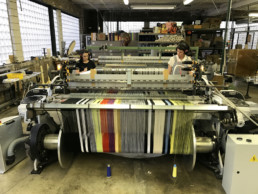
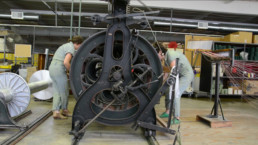
The Weaving Mill is the collaborative studio of Matti Sloman and Emily Winter. We are an artist-run industrial weaving studio in Chicago. We make projects of our own, textile and otherwise, that respond to the practice of running a small industrial mill. We design and make fabric in collaboration with other artists and designers. Working with people of diverse textile experience, we aim to fill the space between the hand and industrially made and bring the mechanics of textile production into wider view. We design, create, and finish everything ourselves in our Chicago studio.
What are some of the most important practices for your creative process?
The Weaving Mill serves as a multifaceted organization: it’s our personal studio, a design studio, a classroom, a residency program, and a production facility. The unifying practices across all of these programs is a commitment to observation, research, and dedication to using overlooked or under-utilized resources whether it be yarn scraps, machinery or physical space. Our designed objects are mostly made with scrap or deadstock yarns. Using the materials available as the foundation, we think hard about how to design towards the best application, or end use, for the fabric we make. Aside from the Artist Collaborations, projects where we throw a lot of rules to the wayside, we strive for TWM objects to be accessible and timeless, but with playful personality.
How does your current creative practice tie into your time spent at RISD?
We co-founded The Weaving Mill in the summer of 2015 after meeting at RISD while earning MFAs in Textiles.
Is there a work/body of work that you are particularly excited about sharing with us at RISD Craft this year?
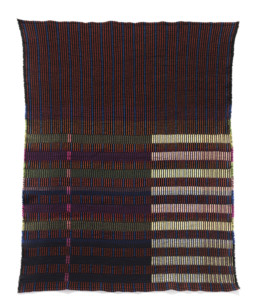
This year we will be bringing a collection of throw blankets, table napkins, bath and hand towels that we really stand behind. All the objects are machine washable, something we find to be important since we want these things to be loved and used without fear of feeling precious. The table napkins in particular are exciting since no two napkins are the same yet they are unified by materiality and by color. It’s a fun play on pattern mixing and we think makes for a stylish and unique table.
Anything else you’d like to share?
We were recently profiled for a very thoughtful piece in Ignant Magazine: https://www.ignant.com/2018/01/16/approaching-the-industrial-as-an-artist-the-weaving-mill-in-chicago/
We have been included in the New City Design 50: https://design.newcity.com/2018/03/01/design-50-who-shapes-chicago-2018/
And we were featured on Chicago Tonight for the work we do in collaboration with Envision Unlimited: https://chicagotonight.wttw.com/2018/01/10/west-town-textile-studio-finds-common-threads-community
To see more of The Weaving Mill’s work, visit www.theweavingmill.com

DOVECOTE COLLECTIVE
Helen Quinn
[1991, Textiles]
Based in Queens, NY
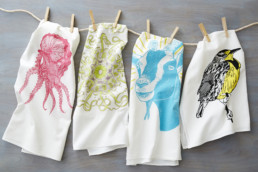
Dovecote Collective is a collaboration between printmakers Ondine Crispin and Helen Quinn. Ondine works primarily with woodblock and linocuts. She is in awe of the perfection of the natural world, especially birds. Helen makes ink drawings that are then made into silkscreens. She prefers creatures of the sea, monsters and alchemical imagery. Together they make textiles for the home as well as fine art prints.
What are some of the most important practices for your creative process?
It takes quite a bit of time, but I love looking at disparate things and then combining them in a kind of salad of imagery. Everything informs us and I find that it is about sifting through sources and experiences to see what sticks. Drawing in a sketchbook and photographing with my phone are quick and helpful when walking down the street or going to a museum. Then back in the studio, cutting paper and drawing with ink often come next, followed by silkscreening in a rented studio space. I often put the finishing touches on prints with gouache so they become one of a kind in the end.
How does your current creative practice tie into your time spent at RISD?
Yes! I first learned to silkscreen at RISD on the wonderful, long tables in the textile department. Also, the Nature Lab continues to be a source of inspiration. Drawing in the Nature Lab all those years ago laid the foundation for so much of what I still do- observing nature and combining the attributes of different creatures.
Tell us about some of your main sources of inspiration.
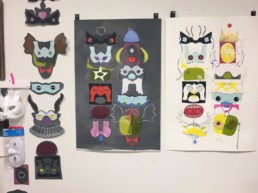
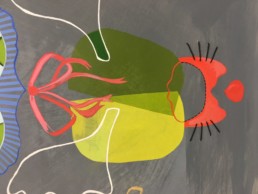
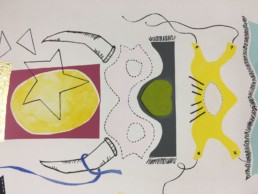
Lately I have been looking at masks, masquerade balls, photos of crowds of people protesting, and the paintings of masked crowds by 19th century artist James Ensor. After playing with silkscreened images of crowds, I have recently started to concentrate only on the masks and stacking them like the totem poles that were were made by Northwest Indian tribes of British Columbia and southeastern Alaska. I love the verticality of the stacking. It seems like another kind of crowd and the prints together are starting to become a taxonomy of the different characters. (The images below are silkscreen on paper with gouache and collage.)
Is there a work/body of work that you are particularly excited about sharing with us at RISD Craft this year?
At RISD Craft, my collaborator Ondine Crispin and I will have silkscreened textiles for the home featuring creatures of the sky and sea. We will also have fine art prints of birds, underwater scenes and my new, strange mask prints.
Any recent press, exhibitions, achievements or awards you’d like to share with us?
In May 2018 I will be going to a residency in Oaxaca, Mexico to study the Zapotec sculptures from the archeological site, Monte Alban. The residency is called Poco a Poco and I am really excited about this trip. I think the feathered head dresses and the large jewlry on the figures will be interesting to add to the masks I have been working on.
To see more of the work from Dovecote Collective, visit dovecotecollective.com


ANCHORPAK
In Maine, ingenuity and resourcefulness are part of our character. We have all sorts of wicked weather and rough terrain to navigate and as a result we have learned to tinker with things to make life go better. It was in this tradition that Anchorpak’s founder, Colin Sullivan-Stevens, a Maine native and Rhode Island School of Design graduate, designed the Anchorpack. He needed something to carry all his stuff to his studio on his bicycle. It needed to feature accessibility, hands free carrying, stability and comfort. Using an old movie screen for material and his geometric expertise from studies in acoustics, he designed and stitched together his first Anchorpak.
It is in the spirit of local community and environmental awareness that Anchorpak manufactures all products in Maine. Maine is a state with a long tradition of quality textile manufacturing but over the years they have lost many jobs to overseas manufacturing. Anchorpak aims to do their part to restore this valuable skill set and employment sector to Maine, and source materials in the USA.
What are some of the most important practices for your creative process?
Brainstorming: My approach to small and large decisions is to attempt to work out flexible connections between the concrete functional aspects at play and the multifaceted soup of ideas and experiences kicking around upstairs. I try to store up on the possibilities even when ideas and things don’t connect because storage is free.

How does your current creative practice tie into your time spent at RISD?
From my current perspective as a designer working outside my field study at RISD which was painting, I was not too surprised to shift my creative practice to address the ergonomic design of bags. The sense that there is always more to understand about everything, that solutions to creative challenges are unlimited if enough focus and hard work are put forth was implicit at RISD and remains the basis from which I begin my work everyday.
Is there a work/body of work that you are particularly excited about sharing with us at RISD Craft this year?
Yes, I am looking forward to being back on Benefit Street to share a design invention I’ve dubbed The Anchorpak bag. I have a feeling that it might appeal in the RISD community where can develops an eye for simple effective product design.
Tell us about some of your main sources of inspiration.
Childhood/Nature: butterflies, building “forts” in the snow and in the woods, downhill skiing, whale watching, flying an airplane at age 11 and The Space Shuttle. Later on… free-jazz, Bjork, the earth, nature and hearty mysteries, food, good civics and well balanced design systems, uncertainty and humanistic ideals.

Any recent press, exhibitions, achievements or awards you’d like to share with us?
Anchorpak has been granted funds by the Maine State Technology Institute in 2015, 2016, 2017 to understand and develop our innovative ergonomic bag design concept for improved everyday carrying. We have been featured in NE regional press often including The Boston Globe and Downeast Magazine editorials, Maine Biz and Old Port Magazine entrepreneur/artist /designer profiles.
Visit anchorpak.com to see more!